



Real Owner Experiences, MPG Numbers, and What Might Be Wrong
Buying a used Honda Civic is supposed to feel like a “safe choice.”
Reliable.
Cheap to run.
Good on fuel.
So when your dashboard suddenly shows 11L/100km (21 MPG) combined…
and 14L/100km (16 MPG) in the city…
Yeah. That doesn’t feel like a Civic anymore.
It feels like a small SUV.
Or worse… something is wrong.
This exact situation happened to a 2012 Civic EX owner who recently bought the car (143,000 km) and started noticing fuel consumption that looked way higher than expected.
And the comments from other Civic owners were pretty clear:
“That’s really bad.”
“My Civic gets way better than that and I don’t even drive smoothly.”
So let’s break it down properly.
The Situation (What the Owner Reported)
A new owner bought a:
2012 Honda Civic EX (4-door)
143,000 km
Automatic transmission
Winter tires
Smooth driving
Very little idling
Oil changed recently
1000 km driven so far
Fuel consumption shown on the console:
✅ 11 L/100km mixed driving (city + highway)
✅ 14 L/100km city-only driving
The owner even double-checked using fuel gauge behavior:
They drove 200–220 km and the gauge showed half a tank used, which matched the console numbers.
So it wasn’t just a “bad reading.”
It was real fuel usage.
What Other 2012–2015 Civic Owners Said (Real Experiences)
Here’s where it gets interesting.
Because other Civic owners jumped in with their own numbers.
And most of them were far lower.
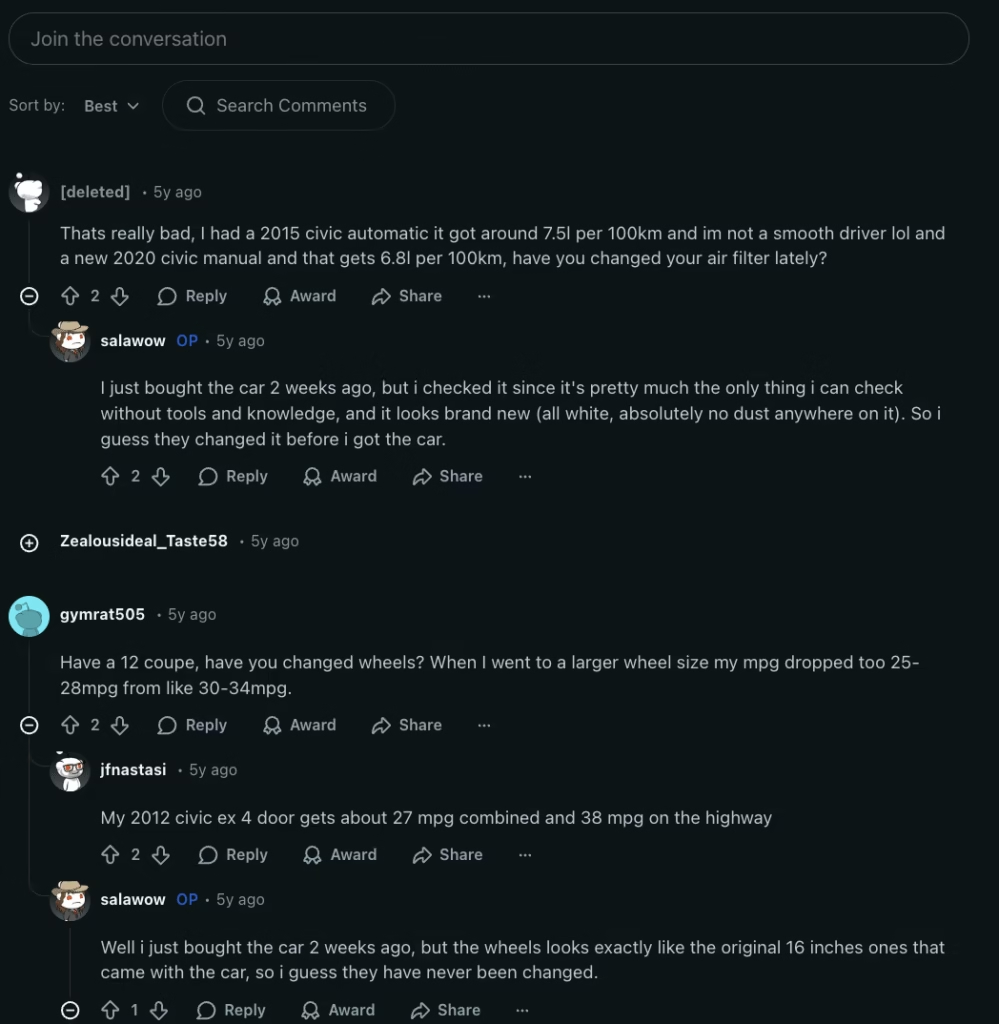
Owner Review #1 (2015 Civic Automatic)
One driver said:
2015 Civic automatic: ~7.5L/100km
…and they admitted they are not even a smooth driver.
That’s a big difference.
If a rough driver is getting 7.5L/100km, then 14L/100km city on a Civic is definitely abnormal.
Owner Review #2 (2015 Auto LX + 2013 Si)
Another Civic owner shared:
2015 Auto LX: 6.7L/100km
2013 Manual Si: 7.6L/100km
They confirmed the same thing:
Your numbers are very high.
They also suggested verifying by tracking full tanks (not just the dash display).
Owner Review #3 (2012 Civic Coupe – Wheel Size Impact)
One Civic owner pointed out something many people forget:
Wheel size changes can destroy MPG.
They said when they upgraded to larger wheels:
Fuel economy dropped from:
30–34 MPG down to 25–28 MPG
So if your Civic has non-stock wheels, heavy rims, or aggressive tires…
It can hurt fuel economy more than you think.
Owner Review #4 (2012 Civic EX 4-Door)
This one is the “classic Civic expectation” comment:
2012 Civic EX 4-door gets ~27 MPG combined
and 38 MPG highway
That’s exactly what most people expect from a Civic.
Not 16 MPG city.
So… Should You Worry?
Short answer?
Yes.
At least enough to investigate.
Because:
11L/100km combined is high.
14L/100km city is VERY high.
Even with winter tires and cold weather, a Civic shouldn’t usually be that thirsty unless something is off.
What Can Cause High Fuel Consumption in a 2012 Civic?
Here are the most common real-world reasons.
And these are the same things Civic owners typically discover when MPG drops hard.
1) Cold Weather + Winter Tires (Yes, It Matters)
This is the “normal” reason.
Winter = worse fuel economy.
Because:
- cold engines run richer (more fuel)
- longer warm-up time
- snow resistance / slush drag
- winter tires have higher rolling resistance
But here’s the truth:
Winter might take you from 7.5L/100km to 9L/100km.
It usually doesn’t explain 14L/100km unless the driving is extreme stop-and-go.
2) Tire Pressure + Tire Type
Even if the pressure is “correct,” winter tires can still reduce mileage.
Also check:
- are the tires oversized?
- are they extra wide?
- are they aggressive tread?
A Civic can feel fine…
but fuel economy drops quietly.
3) Stuck Brake Caliper (This One Is Common and Sneaky)
A sticking caliper can kill MPG.
Signs:
- one wheel gets hotter than others
- car feels slightly “heavy”
- burning smell after driving
- uneven brake pad wear
- steering feels weird sometimes
This is a major MPG killer because the engine works harder just to move.
4) Dirty / Failing Oxygen Sensor (O2 Sensor)
The Civic relies on sensors to control fuel mixture.
If the oxygen sensor is tired or inaccurate:
- engine runs richer
- MPG drops
- sometimes no obvious symptoms
- sometimes no check engine light yet
A weak sensor can still “sort of work” but waste fuel.
5) MAF Sensor / MAP Sensor Issues
Depending on the engine setup, if air measurement is wrong:
Fuel mixture becomes wrong.
That means:
More fuel than needed.
Less efficiency.
More consumption.
Sometimes cleaning helps.
Sometimes replacement is needed.
6) Old Spark Plugs (Especially at 143,000 km)
This is one of the most realistic causes.
If spark plugs are old:
- combustion is weaker
- engine loses efficiency
- you use more throttle
- fuel economy drops
A lot of Civic owners don’t change plugs until the car starts misfiring…
But MPG usually suffers long before that.
7) Transmission Behavior (Automatic + City Driving)
Automatic Civics can drink fuel in stop-and-go traffic.
Especially if you do:
- short trips
- constant braking
- constant acceleration
- lots of red lights
Some owners also mentioned using D3 frequently in the city.
That keeps RPM higher and can increase fuel usage.
8) Bad Thermostat (Engine Never Warms Up Properly)
If the thermostat is stuck open:
- engine stays cold longer
- fuel mixture stays richer
- heater feels weak
- MPG drops
This is a silent fuel economy killer.
9) Fuel System Issues (Injectors / Fuel Pressure)
Less common, but possible:
- leaking injector
- fuel pressure regulator issue
- poor spray pattern
This can cause fuel usage to rise without dramatic symptoms.
10) Alignment Issues
Bad alignment causes rolling resistance.
You won’t always feel it…
But your MPG will.
Signs:
- car pulls slightly
- uneven tire wear
- steering wheel not centered
Quick Reality Check: What MPG Should You Expect?
Most owner reports in the discussion were around:
6.7–7.6L/100km (31–35 MPG)
Highway: 38 MPG is possible
So even if you adjust for winter:
A normal winter combined number might be:
8.5–10L/100km
But 11–14L/100km?
That’s beyond normal.
What You Should Do (Simple Checklist)
If you want a clean plan, here’s the order that makes the most sense:
Step 1: Calculate Real Fuel Economy
Do the manual method:
Fill tank → reset trip → drive → fill tank again
Then calculate:
(Liters used ÷ km driven) × 100
This removes any dashboard estimate errors.
Step 2: Scan for Codes (Even If No Check Engine Light)
Sometimes cars store “pending codes.”
A basic OBD2 scan can reveal hidden issues.
Step 3: Check Brake Drag
After driving 10–15 minutes:
Carefully check if one wheel area feels hotter than the others.
If yes → brakes may be dragging.
Step 4: Replace Spark Plugs (If They’re Old)
At 143,000 km, it’s very possible they’re overdue.
This is one of the best “fuel economy maintenance” jobs you can do.
Step 5: Check Thermostat + Coolant Temp
If the engine takes forever to warm up…
Or the temp gauge sits low…
Thermostat could be the issue.
Step 6: Check Filters + Basic Maintenance
Even if the air filter looks new:
- check cabin filter (not MPG but helps overall)
- check PCV valve
- check for vacuum leaks
Final Thoughts (What Owners Basically Confirmed)
The Civic community reaction was consistent:
Your fuel economy numbers are too high for a Civic, even in winter.
Most drivers with similar models report:
- 6.7–7.6L/100km
- ~27 MPG combined
- ~38 MPG highway
So if you’re seeing:
11L/100km mixed
14L/100km city
You’re not crazy.
Something is likely causing it.
And the most common real culprits are:
✅ old spark plugs
✅ stuck brake caliper
✅ thermostat issue
✅ sensor problems (O2 / MAF / MAP)
✅ heavy tires / wrong wheel setup
✅ pure stop-and-go short trips