



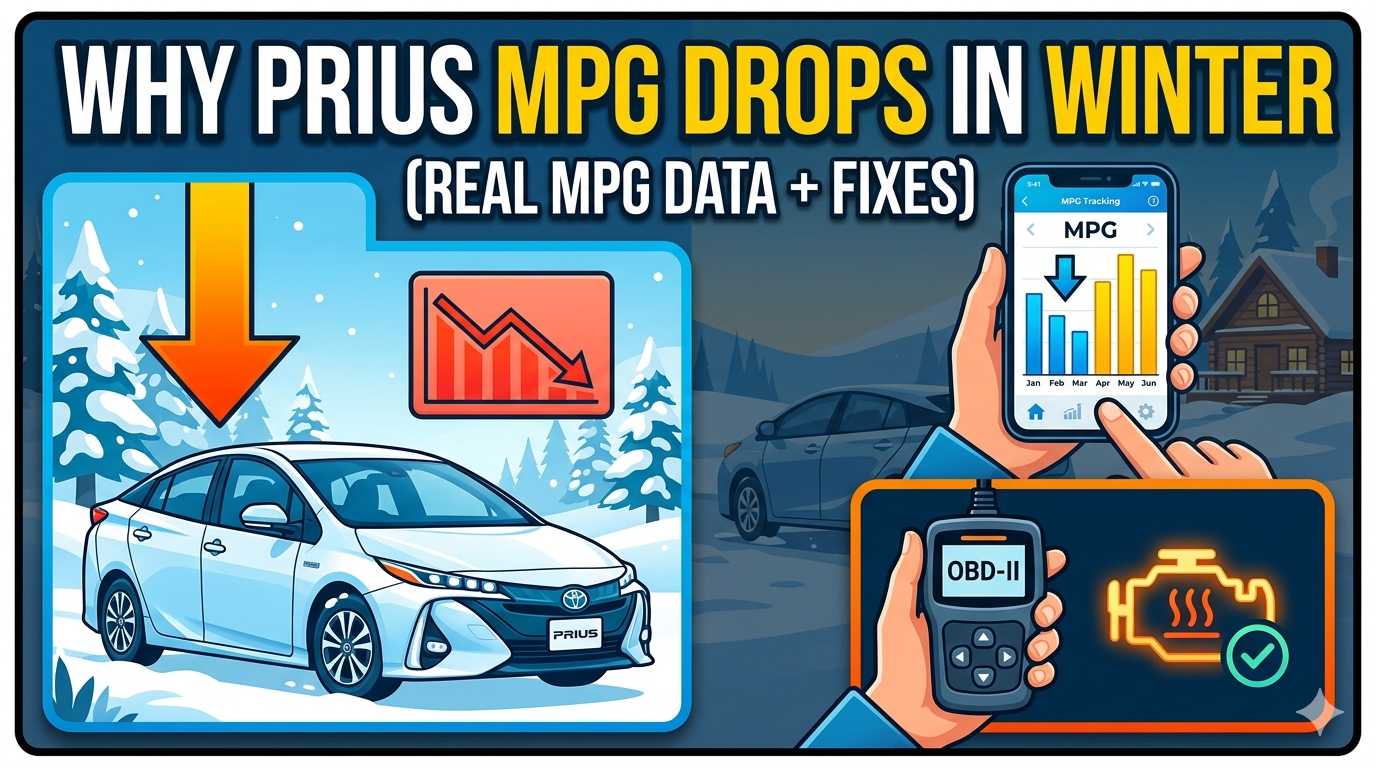
Why Prius MPG Drops in Winter ?
If your Toyota Prius gets worse fuel economy during winter, you are not alone. Many Prius owners notice a significant MPG drop once temperatures fall below freezing. Cold weather affects hybrid systems more than many drivers expect because the gasoline engine runs longer, the hybrid battery becomes less efficient, and cabin heating increases fuel consumption.
A Prius can easily lose 10–20 MPG during harsh winter conditions, especially on short trips.
How Much MPG Does a Prius Lose in Winter?
Real-world winter MPG varies depending on temperature, trip length, driving speed, and heater usage.
| Outside Temperature | Typical Prius MPG | Efficiency Level |
|---|---|---|
| 70°F (21°C) | 55–60 MPG | Excellent |
| 50°F (10°C) | 48–55 MPG | Very Good |
| 32°F (0°C) | 40–50 MPG | Reduced |
| 20°F (-6°C) | 35–45 MPG | Poor |
| Below 0°F (-18°C) | 30–38 MPG | Very Poor |
Many owners see the largest MPG drop during:
- freezing mornings
- short city trips
- heavy heater usage
- snow driving
Why Cold Weather Reduces Prius MPG
Several winter-related factors reduce Prius fuel efficiency.
Longer Engine Warm-Up Time
The Prius hybrid system keeps the gasoline engine running longer during cold weather to reach operating temperature.
During warm-up:
- EV mode becomes limited
- fuel usage increases
- the engine cycles more frequently
Short drives become especially inefficient because the engine may never fully warm up.
Reduced Hybrid Battery Efficiency
Cold temperatures reduce hybrid battery performance.
This affects:
- regenerative braking
- electric motor assistance
- battery charging efficiency
As battery performance drops, the gasoline engine works harder to compensate.
Cabin Heater Increases Fuel Consumption
The Prius uses engine heat to warm the cabin. When the heater is running, the engine stays active longer to maintain coolant temperature.
Heater Usage vs MPG Loss
| Heater Usage | MPG Impact |
|---|---|
| Heater Off | Best MPG |
| Moderate Heat | Small MPG Loss |
| Maximum Heat | Large MPG Loss |
High heater settings and windshield defrost can noticeably reduce winter MPG.
Cold Air Creates More Aerodynamic Drag
Cold air is denser than warm air, increasing aerodynamic resistance.
This causes:
- higher fuel consumption
- more engine load
- worse highway efficiency
The effect becomes larger at higher speeds.
Why Short Trips Hurt Prius MPG the Most
Short trips are one of the biggest causes of poor winter fuel economy.
Example Winter MPG by Trip Length
| Trip Length | Typical Winter MPG |
|---|---|
| 2 Miles | 25–35 MPG |
| 10 Miles | 40–50 MPG |
| 30 Miles | 50–58 MPG |
The engine spends much of a short drive warming up instead of operating efficiently.
This is why many Prius owners experience:
- very low MPG during errands
- poor fuel economy in city traffic
- large winter MPG swings
Do Snow Tires Reduce Prius MPG?
Yes. Winter tires usually reduce fuel economy because they increase rolling resistance.
Tire Type vs MPG Impact
| Tire Type | MPG Impact |
|---|---|
| Low Rolling Resistance Tires | Best MPG |
| All-Season Tires | Moderate MPG Loss |
| Winter Tires | 2–5 MPG Reduction |
Although snow tires reduce MPG slightly, they improve:
- traction
- braking
- winter safety
AWD vs FWD Prius Winter MPG
AWD Prius models generally produce slightly lower fuel economy during winter compared to FWD models.
Reasons include:
- additional drivetrain weight
- more mechanical resistance
- rear motor activation in slippery conditions
The MPG difference is usually small but becomes more noticeable in severe winter weather.
How to Improve Prius MPG in Winter
Combine Short Trips
Fewer cold starts significantly improve efficiency.
Check Tire Pressure Frequently
Cold temperatures reduce tire pressure rapidly.
Low tire pressure:
- increases rolling resistance
- reduces MPG
- causes faster tire wear
Temperature vs Tire Pressure Loss
| Temperature Drop | Approximate PSI Loss |
|---|---|
| 10°F | 1 PSI |
| 20°F | 2 PSI |
| 30°F | 3 PSI |
Use Eco Mode
Eco mode reduces:
- throttle sensitivity
- heater demand
- aggressive acceleration
This helps improve winter fuel economy.
Avoid Excessive Idling
Long warm-up idling burns unnecessary fuel and reduces overall efficiency.
Park Indoors if Possible
Keeping the hybrid battery warmer improves cold-weather performance.
Real-World Prius Winter MPG Reports
Many Prius owners report the following winter MPG ranges.
| Driving Condition | Typical MPG |
|---|---|
| Mild Winter Commute | 45–55 MPG |
| Freezing City Driving | 35–45 MPG |
| Heavy Snow + Short Trips | 30–40 MPG |
| Long Highway Driving | 45–52 MPG |
Is It Normal for a Prius to Get 40 MPG in Winter?
Yes. In freezing conditions, 35–45 MPG can be completely normal depending on:
- trip length
- heater usage
- driving speed
- outside temperature
Many drivers panic unnecessarily when winter MPG drops suddenly.
Why Hybrids Lose More MPG in Winter Than Regular Cars
Hybrid vehicles rely heavily on:
- battery efficiency
- regenerative braking
- engine stop/start systems
Cold weather negatively affects all three systems.
This makes hybrids more sensitive to winter temperatures compared to many traditional gasoline vehicles.
Frequently Asked Questions
Does remote start reduce Prius MPG?
Yes. Remote start increases idle time and fuel consumption during winter.
Does highway driving improve winter MPG?
Usually yes, especially after the engine reaches operating temperature.
Does using the heater reduce Prius MPG?
Yes. Cabin heating forces the gasoline engine to run longer.
Is winter MPG loss permanent?
No. Fuel economy usually improves automatically as temperatures rise.
Final Thoughts
Winter MPG loss in a Toyota Prius is completely normal. Cold weather reduces hybrid battery efficiency, increases warm-up time, and forces the gasoline engine to run more frequently.
The biggest causes of poor winter MPG include:
- short trips
- excessive heater usage
- cold starts
- snow tires
- high-speed highway driving
Simple changes like checking tire pressure, combining trips, and reducing unnecessary idling can significantly improve winter fuel economy.
Even during harsh winter conditions, the Prius remains one of the most fuel-efficient vehicles on the road.
Please read more blogs here :
- Toyota Prius MPG By Year (2001–2026)
- Why Prius MPG Drops in Winter (Real MPG Data + Fixes)
- Prius LE vs XLE vs Limited: Which Trim Is Worth It?
- Toyota Prius MPG by Year (2016–2026) – 57 MPG Latest Models + Real-World Data
- 🚨 2024 TOYOTA TACOMA MPG – WHY ARE TRUCK OWNERS STILL MAD? 🚨
- 2026 RAV4 Hybrid Fuel Consumption (USA)
- 🚙 2026 Toyota 4Runner Hybrid Gas Mileage – Worth the Hype?
- 2025 Toyota Tacoma Hybrid MPG: Fuel Efficiency, Performance & Buyer’s Guide 🚙⚡
- Real Life Toyota Corolla Cross Hybrid MPG Test – What Owners Are Really Getting
- 2025 Toyota Sequoia Hybrid MPG 🔥 Real Mileage Info
- [🔥2026] Toyota Highlander Gas Mileage – Updated
- Toyota Prius MPG – Real-World [🔥2026 Update]
- 2025–2026 RAV4 Hybrid MPG (EPA + Real-World Tested + Fuel Cost)